Showing posts with label bbc. Show all posts

Sunday, 27 February 2011

The Libyan rescue

The Government has had some bad press over the last week over the so-called 'fiasco' of the Libya crisis, whereby some people thought that we were too slow in getting people out. Radio 5 was reporting that a Turkish ship had got some of their citizens out of a port city, and then went to talk to the wife of a Scotsman trapped at an oil complex in the middle of the desert,

This is where I started to smell a rat. The oilmen were in a far worse predicament than the Turkish workers; many were trapped in the middle of nowhere with no transport (the locals having stolen their vehicles), whilst the Turkish workers mentioned were concentrated in the cities.  Libya is hardly a friendly country, and I can see why the government might be concerned that they would take the flying in of a plane without permission to be an unfriendly act. Comparing the two in such a forthright manner was disingenuous at best.

Then came Cameron's apology. Firstly I could not see what he was apologising for: the government were doing things, albeit in a fluid, complex situation that was hard to manage. But I must say it is a relief to have a country that does manage to apologise, unlike out previous PM for whom 'sorry', like 'cuts', was truly a hard word to say.

Now the oil workers have been rescued, allegedly by the SAS and/or the SBS. An SAS/SBS operation is hardly a quick thing to set up (just getting the teams into position is time-consuming, yet alone the information gathering and planning).It looks as though the SAS team flew in on commercial flights on Tuesday - whilst these idiots were crying out 'fiasco!', and their weapons were being dispatched in diplomatic bags. So the Government was doing something, and apparently doing it well; they just could not speak about it.

It is well known that the first aircraft to be sent had some 'technical issues' that delayed its takeoff by half a day - these failures have not been explained, but one theory doing the rounds was that it was delayed so extra personnel and equipment could be put on board. Although there is no proof, it does make some sense.

Incidentally, the Germans flew in similar missions on the same day, and the media are failing to mention that a US catamaran has been stuck in Tripoli harbour for 48 hours with technical difficulties.

The supposed failure to rescue our citizens was headline news on the BBC News website, as was Cameron's apology. This morning, as what appears to be a fairly daring rescue has occurred, and may still be ongoing, it does not even appear on their front page, and a reporter on the News Channel has cast scorn on the idea it was a 'daring' rescue.

And they are not mentioning Labour's strong links with Gaddaffi...

The media ought to be hanging their heads in shame about this. The fiasco was in their reporting, not in the operations.

Sunday, 2 January 2011

In praise of the Royal Institution Christmas Lectures

This Christmas I was glued to the TV for the Royal Institution Christmas Lectures. This year the topic was 'size matter', presented by the spectacularly-named Dr Mark Miodownik.

This year it moved back to its spiritual home on the BBC, but was unfortunately reduced from five to three episodes.

Being of a relatively scientific bent, there was little that was new to me in this year's presentation. Despite this, it was still fascinating stuff. Science is notoriously difficult to present to children, yet the lectures never fail to arrange complex topics into a form that children can comprehend. Strangely, I never fail to learn something, even if it is something long forgotten.


For instance, take the last of this year's three programs. It went from why some materials look like solids but are actually liquids, to how mountains sink into the earth's mantle, to the limits of skyscrapers height and carbon nanotubes to space elevators. All of this was told in an accessible manner without a single equation.


These lectures have been running since 1825, and the names of some of the presenters go through the luminaries of British and world science: Michael Faraday, John TyndallFrank Whittle (strangely talking about petroleum and not the jet engine), the genius Eric Laithwaite, Desmond Morris, David Attenborough, Heinz Wolff, Carl Sagan, Richard Dawkins, Kevin Warwick and Susan Greenfield, amongst others. Each series of lectures have been televised since 1966. Google Books has a potted history of the lectures.

Faraday started the lectures to teach children about science; a pioneering ambition, especially for those pre-Victorian times. Children still dominate the audience, and the presenter often encourages them to take part in experiments.

It is so easy to dumb down science - something that the media never fail to achieve with sensationalist headlines. It is therefore somewhat amazing that the Royal Institution manage to make science accessible without dumbing it down. I can only hope it will continue in a world where the truly good science programs - QED, Horizon, and Equinox - have all disappeared.

Monday, 27 December 2010

BBC Weather, part 4

So it is over. on the 3rd I finally (*) received a response from BBC Complaints that explains the discrepancy I have seen in the BBC Weather system on-line. The previous installments of the saga can be found in part 1, part 2 and part 3.

I reproduce the relevant part of the email below (I emailed them to as for permission, but after two weeks have had no reply). I have included it as I believe that it may be of interest to others.

As for the thinking behind the forecasts they are sent to us from the Met Office via two different feeds, and each feed drives what weather symbol is shown.

Daily Weather Symbol
The daily weather symbol indicates the most representative weather type for the whole of the relevant day or night. This could either be the predominant weather type - that is the weather that lasts for the longest period of time, or alternatively, the most significant weather type.

So if a day is forecast to be predominantly sunny with the possibility of a brief shower, then we are likely to see a sunny symbol rather than shower symbol. However, a thunderstorm symbol may appear if a thunderstorm is expected in an otherwise largely dry day. For the purposes of the forecast the day covers the period from 0600 to 1800 UTC and the night from 1800 to 0600 UTC on the following day.

Three Hourly Weather Symbol:
The weather symbol that appears for each three hourly timestep indicates the weather that is expected at or near the relevant location, around the time indicated.

For example if a shower symbol appeared for Exeter at 1500, we're saying there is a chance of a shower in the Exeter area at, or close to 1500 (there could be one a short distance away and it may actually occur at 1430). As the three-hourly forecast is 24 hours from the point when it is viewed, depending on the time at which you are viewing the forecast the most representative weather symbol for the day might not have appeared.

I think that this explains the observed problems.

It has been an interesting little diversion, and shows the problems there can be in delivering the weather forecast, yet alone forecasting it in the first place.


(*) I received the email in the morning. At first, when viewed in MS Live Mail application, it showed as being empty. Only in the evening, after a couple of glasses of wine, did I dig further. I noticed that the size of the mail was 7K, which was much bigger than I would expect for normal email headers. So I dug into the system and retrieved the plain text of the email as a file. It showed a large section like this:
PEZPTlQgZmFjZT0iVGFob21hLCBWZXJkYW5hLCBBcmlhbCIgc2l6ZT0yPgo8UCBjbGFzcz1Nc29O
This was obviously some form of encoding, and a few lines above was:
Content-Transfer-Encoding: base64
So the email had been encoded in base64. This is often used when you need to transmit binary data - for instance images or audio - over email, which is text-only. I went onto an on-line decoder and retrieved the base text of the message. I have no idea if the problem was with the BBC mail system, a corruption during sending or Live Mail's inability to decipher it.

Wednesday, 22 December 2010

Hysterical journalism

The media narrative on the snow is becoming quite hysterical. Of course it is easy for me to say this, as the snow down here in Southampton has not been particularly bothersome. They are all at it: the BBC, Sky and the newspapers, hand-wringing and asking why 'we' (by which they mean anyone but themselves) cannot cope with snow.

Take BBC News 24 on Monday afternoon. They interviewed a spokeswoman for the Burlington International Airport in Vermont, who claimed with pride that their airport rarely closed due to snow. The presenter did not ask any particularly pertinent questions, and seemed keen to push blame onto BAA, the company that operates Heathrow.

So I thought that I would look up Burlington International Airport. The link shows that in 2008 the airport performed 72,189 individual aircraft operations.

Compare this with Heathrow, which had 466,393 individual aircraft operations in 2009. As can be seen, Heathrow is six times as busy with only two runways. This means that Heathrow is far busier, and has less slack for doing maintenance of runways, taxiways and stands between flights. Indeed, Heathrow is operating at 98% of capacity. This means that there even the slightest delay to operations can cascade down. What is amazing about Heathrow is that they manage to run services as well as they do.

Again as a comparison, Birmingham Airport had 101,221 flights in 2009.

True, things could have been done better. But I am getting fed up with journalists - many of whom have had no experience of engineering - criticising things they have little idea of.

Take a common complaint: that the organisations involved (the airlines, the airports or the railway companies) do not give enough information out. This complaint assumes one massively important thing, and that is that the organisations *know* what the situation is. Snowfall in Britain can be hard to predict, both in when it falls, the severity and the duration. We must all have driven and seen heavy snow lying in one area, and green fields just a few miles away.

The BAA people will be spending all their time trying to get as many planes in the air as possible, and the situation must be extremely fluid. Planes take time to clear, and the authorities will not know with any certainty which plane might be the next to be ready to go. Therefore it must be next to impossible to tell an individual passenger when his plane will be leaving.

There is one thing that I find amazing: that passengers were left on a plane for hours after it had left the gate. This was wrong, and should be avoided in the future. Again, this can be easier said than done. It would be interesting to see where the fault for that lies. Was it the airline or BAA who made those passengers suffer?

Much credit to Channel 4's seven o'clock news, whose reporting and criticisms appear to be much more valid. Having said that, they did broadcast an interview with an American lady last night who said that the travel chaos were similar to the images she had seen of the aftermath of Hurricane Katrina. Yeah, right. A few people getting delayed or changing their travel plans is anything like a disaster where 1,800 people died and thousands lost their homes. Some people need to get a sense of perspective...

Friday, 17 December 2010

Dirk Gently (and not his holistic detective agency)

Last night Sencan and I watched the BBC 4 adaptation of Douglas Adams' 'Dirk Gently's Detective Agency'. This book has a very different tone to Douglas's Adam famous work, the Hitch Hikers Guide to the Galaxy, yet is very popular amongst fans. If you have not read the book and want to know the true genius of Adams' work, then read the plot synopsis at the Wiki link above. Only Adams could link time travel, Coleridge, the Big Bang and saving the entire Human race from extinction.

We saw the adaptation immediately after seeing 'The voyage of the Dawn Treader' at the cinema, making it truly a voyage back into my childhood and teenage years. Both are wonderful if flawed books, with concepts that at times stretch the mind.

The protagonist is Dirk Gently, a university drop-out who now works as a detective. Instead of looking for clues like other detectives, Gently collects seemingly random events and determines the connections between them, solving cases by forming conclusions that are as impossible as they are correct. This central concept of the book - the fundamental interconnectedness of all things - is thankfully at the core of the adaptation.

The book's Dirk Gently is an impossibly eccentric character. The Green Wing's Stephen Mangan played Gently with a certain panache, and it is hard to think of an actor who could have done a better job. It was a solid piece of comic acting.


Yet fans of the book would find significant problems with the adaptation. Dirk Gently's right-hand man, Richard MacDuff, is portrayed as an unemployed layabout, whilst in the book he is a well-paid, highly competent software engineer. You can imagine why I believe that this is a retrograde step. TV seems to think that all software engineers are geeks, and therefore treats them as comedy items.This is doubly tragic as Adams was a well-known techno-head, and it was obvious in the book that he favoured the MacDuff character.

It would have been impossible to condense all the concepts in the book into a one-hour TV program. It would make a great two-hour film, but this adaptation felt more than a little rushed. In particular, some of the most important plot threads were missing. It did not feature a major character called the electric monk (aside from a fleeting mention on a whiteboard). This was a particular shame, as the monk was one of Adams' better creations.

Many other beloved features from the book were missing. For instance, Dirk Gently's hat and the sofa stuck on a stairwell. The references to Schrodinger's cat in the adaptation appears to have been stuffed in, and had none of the plot importance that it had in the book.

It was also clear that the adaptation suffered from a low budget. This was most obvious during a scene where a warehouse blew up - the CGI of the actors leaping out of the way was farcically poor, similar to countless amateur scenes on YouTube. Likewise, some of the sets were noticeably of low quality.


The humour helped take my mind off these flaws. There were many truly comedic moments; for instance when Dirk Gently develops a twinge in his shoulder and goes to see MacDuff's girlfriend (ably played by Helen Baxendale). These laughs had more to do with Mangan's acting than the squeezed plot or writing.

This adaptation will have fans disappointed and everyone else utterly confused. Unfortunately the magic of the books was somewhat lost as the plot was squeezed and malformed into the TV format. But perhaps that is for the best, as Adams' original plot was convoluted to say the least. The resultant simplification of the plot may just have made it accessible to the general public.

It felt like a pilot; a program that desperately wanted to be part of a series. If so, then I can only hope that we see more of Dirk Gently sometime soon. And please, please include the electric monk...

Tuesday, 2 November 2010

BBC weather, part 3

In my earlier posts, I discussed a problem where the BBC Online weather system gave inconsistent results between the summary and detail forecasts. Note that this is *within* the forecast service provided by BBC Online.

I submitted a complaint to them through their complaints system; not necessarily as a disgusted-of-Tunbridge-Wells type thing, more to inform them that there was a problem.

Yesterday afternoon I received a reply. It consists of a few paragraphs, of which most are boilerplate. The ones that actually contain pertinent information are as follows:
I understand that you're unhappy with the weather forecast as you it was inconsistent between bbc.co.uk and elsewhere on the BBC.

The nature of our climate is such that there are times when the weather doesn’t behave as forecast. We are confident that we are using the best source of forecast data, which we obtain from the Met Office - who have an extremely good record globally. We do feed back to them concerns about forecast inaccuracy and also put pressure on them to improve their accuracy.
Well, they really did not get the point I was making. I was not concerned about inconsistencies between bbc.co.uk and elsewhere on the BBC (e.g. broadcast forecasts); it was about glaring inconsistencies *within* the web service.

My flabber is well and truly ghasted. My original complaint to them included a link to the original blog post, which contained screenshots detailing the problem. Not only did they not bother to understand the reported problem, I doubt they even bothered to read the information given.

It should also be noted that they have essentially closed the issue, and have not provided a means within the email by which to continue the correspondence.

Another comment about their complaints system: after you submit a complaint, you get no acknowledgement from the system. Many other such systems email the sender immediately with a copy of the message and a reference number; this way you can check the message has been received and that your email address is correct. I had nothing from the BBC until this reply. Part of me wondered if I had entered the correct email address.

The question is, what do I do next? Do I just forget about it, or do I try and get them to understand the problem? Is it possible for me to reopen the issue that they appear to have closed? Am I going to get trapped in an endless loop of bureaucracy?

Although I may be annoyed at one part of the BBC, I was thoroughly entertained by their output last night on BBC Four: the excellent 'Atom' program was followed by the lovely Victoria Coren in 'Only Connect'.

Truly a feast for both mind and eyes.

Monday, 25 October 2010

BBC Weather, part 2

Without meaning to sound like a weather bore, the bug with the BBC online weather system that I noticed last week occured again this morning. Last night the forecast for today was bright sunshine; a few minutes ago it showed heavy rain:


 Drilling down, the summary forecast for today was heavy rain:

Yet the detail shows bright sunshine, as expected from last night's forecast.

I sent in a complaint about this last week to the BBC, and have yet to receive a response. I can fully understand why weather forecasts may be inaccurate - predicting the future is an enormously complex task in a system as complex as weather. However, there is no reason for it to be internally inconsistent in this manner.

How many people are getting confused and altering plans because they are reading the summary and seeing rain is forecast, when in reality sunshine is expected?

I set my location to Glasgow, and the same problem occurs - the summary forecasts heavy rain, whilst the details forcasts sunshine.

York was more interesting. Tomorrow's weather for York shows 'sunny intervals with light rain forecast for 10.00', yet the detail shows cloud and light rain all day, with no sun. This shows that the problem is far more complex than just displaying heavy rain for forecast sunny days.

Something in the summary->detail translation is seriously mucked up. It makes me wonder what sort of system they use to generate the summary weather from the detail. The problem seems to happen in the early hours of the morning (I have ye to see it in the evening), so it could be a problem with the way they update the forecast.

Wednesday, 20 October 2010

BBC weather

I keep a close eye on the weather forecast when I go walking. The handiest of these is on the BBC website, although I have found that their web-based system is, frankly, odd. It seems to change randomly, and also bears little relevance to the broadcast weather updates (or, indeed, the actual weather when it happens).

I have considered writing a utility to automatically grab the BBC weather forecast every six hours, logging the changes and comparing with the Met Office's record of what really happened with the weather. This has remained low down on my to-do list.

Today, however, I got firm evidence with none of the hassle.

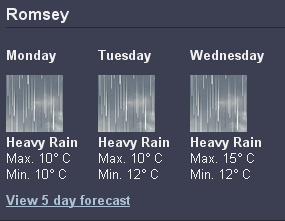
Last night, before I went to bed, the summary forecast (with home area set to Romsey) showed sunshine for the next three days. This morning, the summary showed heavy rain, as seen below. All images were made within a period of five minutes shortly after 08.00 this morning.

The forecast for heavy rain was strange, as a glance outside the window showed a cloudless sky and the first ground frost of the year. Of course, it may rain later, so I drilled down further to look at today's weather in detail:


Note, bright sunshine and no sign of the heavy rain. The location is still set as Romsey. And Thursday's details:

Finally, on Thursday evening, we get a light rain shower (not the 'heavy rain' forecast). So the summary predicts heavy rain for the next two days, but the details show bright sunshine. Obviously these both cannot be correct. The questions is, how can we rely on the weather forecast when it is not even internally consistent?

Monday, 2 August 2010

Sherlock

The BBC broadcast the second in the promising Sherlock series last night. The story of 'The Blind Banker' - involving murder and smuggled artefacts - was obviously based on the Sherlock Holmes book, "The sign of the Four".

First, the positives: the series so far has been very good. True, it has been updated to take place in contemporary instead of Victorian London, but the writers have given more than a quick nod to the original material. The first episode was excellent, with the introduction of Holmes and Watson deftly handled.

Whilst good, last night's episode was slightly disappointing. There were a few unnecessary get-out-of-jail free cards; for instance a struggling Watson knocks an automated crossbow that is aimed at his girlfriend, making the bolt miss her and hit the man who is fighting Holmes. Such a shot has to be a million to one, and was lazy writing.

The biggest problem, however, was Sarah, Watson's love interest. Although ably-played by Zoe Telford, the character's actions made little sense. First of all, some background. In 'The Sign of the Four', Arthur Conan Doyle introduces Miss Morstan, who later becomes Watson's wife. Therefore there has to be an assumption that Watson and Sarah will become an item in later stories.

In this adaptation, they meet as Watson applies for a job as a locum in a surgery run by Sarah. She hires him, but he falls asleep during a surgery, causing a queue of patients to build up. A normal reaction would be for her to reprimand him; instead she takes over his patients and does not seem to mind. Shortly after, she agrees to go out on a date with him. Her reactions were nonsensical and made her seem unprofessional.

It would have been easy for he plot-line to have been more deftly handled. For instance, she could have noticed that Watson was tired, but that he worked diligently through his line of patients. As a thank you, she invites him out. With a small change you have improved Watson's character (he is a diligent worker) and hers (her actions make sense).

Whilst on their date at a Chinese circus, Holmes gets attacked. Watson runs to his aid, as does Sarah. I would really wonder whether any woman would run up into a fight with two people she hardly knew - she had only just met Sherlock that evening. More likely that she would stand back or call the police. Again, it was sloppy writing - there needed to be a reason for her to risk her own safety by going to their aid.

This sort of thing happens all the time in TV dramas, but it stood out in last night's episode due to the brilliance of the rest of the plot. These are, however, minor foibles in what could well become a classic retelling of familiar tales.

Sunday, 25 July 2010

BBC and Apple

I have long noted that the BBC appears to be somewhat in awe of Apple. Any Apple product release gets heavily trailed on BBC Radio, TV and Online, whereas those of its competitors do not. As an example: when the original iPhone was released in 2007, Radio 5 had a long segment in which a breathless technology correspondent lovingly and excitedly gushed over the newly-arrived phone. It was not edifying radio. A similar situation happened with the iPad release earlier this year.

The problem is simple: the iPhone is a smartphone, and Apple is just one player in that market. Smartphones are phones with capabilities that extend a great distance past simply making calls. They can run third-party applications, read email, take photographs, access the Internet and preform many complex tasks. They are the high-end of the mobile phone market, and this is important: the low-end (currently dominated by Nokia) is low-margin and is continuously being squeezed by volume handset manufacturers.

There are three other major companies in the smartphone market: Nokia, who are by far the largest handset maker in the world, RiM, who make the Blackberry, and Google, who have an open source and hardware smartphone system called Android. The figures are telling:Nokia sold 88 million smartphones globally in 2009, and 34 million Blackberry units were sold. Apple sold 24 million units in the same year. Android sold relatively few phones, a result of its recent release. To put these figures into context, Nokia sold 440 million normal (i.e. non-smart) mobile phones in the same period.

Therefore it is of interest that the BBC rarely report on developments to do with Nokia, Blackberry or Android. Worse, they seem only to repeat Apple news (or hype). Even when Apple comes under criticism - as it has done recently with the antennae issue - the BBC more or less report Apple's line without significant question. The BBC are experts in broadcast technology and have some brilliant engineers; surely they could have done their own investigation into the issue instead of parroting Apple's PR?

It is not the BBC's job to repeat Apple hype. If anything, the BBC should be strictly questioning the hype that lies behind the manufacturer. Yet that is not their way, and I wonder why this situation has arisen.

And unfortunately it gets worse. Recently the Government has stopped departments from spending hundreds of thousands of pounds developing applications for the iPhone and not those from rival manufacturers. This was an utter waste of public money when Apple's market was so small. (as an aside, the Labour party created an iPhone app before this year's election to keep in touch with their helpers; an odd choice due to the expense of the iPhone and its non-ubiquity).

The BBC have not learnt this lesson. It has been reported that the BBC have finally released an application that will allow iPhone users to access BBC News. The release was delayed over concerns that it would impact the rest of the industry (it does not say if this concerns refer to the media or technology industries). The BBC Trust have now overruled these concerns, allowing the iPhone app to be released.

I would like the BBC to answer the following questions:

  • Why did they choose to release an iPhone app first, instead of ones for Blackberry, Nokia or Android phones?
  • Have they done an impact statement to see how this would advantage Apple over other manufacturers?
  • How many BBC journalists and correspondents receive gratuities (monetary or services) from Apple and other manufacturers?
  • What advantages does an iPhone app give over web access to the same news? Most mobile phones can access the web nowadays, and the BBC already have mobile portals.
  • How much did the iPhone app cost to make?
  • Can this expense be justified?

These are important questions that need to be answered to ensure that the BBC are fulfilling their public service remit.

I have no side in this debate; my mobile phone is most certainly not a smartphone. Yet I think it is vital for the BBC to answer these questions; I fear that they will not. If this situation continues then the BBC will be swaying an entire technology sector towards one company.

I fear the true reason behind these decisions is that Apple and the iPhone are seen as being sexy, and this has swayed decisions and reporting towards them. If so, then this is a terrible waste of licence-payers money.

Monday, 7 June 2010

Thatcher hatred

Three of the candidates for the leadership of the Labour Party spoke at a GMB meeting today. All went quite smoothly and boringly until John McDonnell claimed that the best way to have improved life in the 1980s would have been "to assasinate" Margaret Thatcher.

He apparently received applause from the room, and none of the other candidates chose to argue the point with him. Even if it was a joke (which, given his track record, I doubt), then it is in seriously bad taste and reflects poorly upon him.

Think about this for a moment: the candidates have 48 hours before the vote; it is a time to set in place their vision for the future of the Labour party and, by extension, the country. It is most certainly not a time for crass comments, and yet he chose to make a comment that is hateful in the extreme.

I wonder whether this statement actually breaks the somewhat draconian incitement to violence laws that his own party introduced whilst in Government.

It is interesting to see how the BBC reacts. His comments are hidden away on a webpage about the meeting, and are then excused by BBC Political Correspondent Ross Hawkins in the following manner:
(the comments) should be seen in the context of the audience it was directed at and the fact Mr McDonnell and the other MPs were explicitly appealing for votes.
So, Mister Hawkins, if an Islamic Preacher in a Mosque was to call for the PM to be murdered, that would be okay because he was just appealing to his audience? Or an Irish Nationalist saying that all English in Ireland had to be killed would be okay because he was just talking to fellow terrorists? It is a measly, biased excuse, and it beggars belief that it is a quote from a BBC correspondent.

I wonder how the BBC would they have reacted if a Conservative MP had said: "the best way to improve life in the nineties would have been to shoot Tony Blair?" I can imagine it would be headline news. When Jeremy Clarkson called Gordon Brown a 'one-eyed Scottish idiot' it was front-page news on the BBC website. This is far worse and yet, apparently, it is excusable.

Unfortunately McDonnell has form. He has previously said: “It’s about time we started honouring those people involved in the armed struggle. It was the bombs and bullets and sacrifice made by the likes of Bobby Sands that brought Britain to the negotiating table. The peace we have now is due to the action of the IRA.”

His poor excuse for this is on the Guardian website.

The IRA tried to assassinate Thatcher. Five people died and 31 were injured, some seriously. I wonder if McDonnell approves of that action? At the very least he should be asked to condemn it.

MPs have to work for all their constituents, not just the ones who vote for them. How would you feel if you were one of the 12,553 of McDonnell's constituents who voted Conservative at the last election? Would his obvious hatred for Thatcher (and, by extension, Conservatives) prevent him from working for you?


There are extremists on all sides of politics. Unfortunately McDonnell has put himself in the limelight by vying for the leadership of the Labour party. Fortunately for the country, he does not look likely to get enough nominations from his fellow MPs to get through to the next round. Perhaps they know the sort of man he evidently is.

John McDonnell, you are a nasty piece of excrement who does not deserve the honour of being an MP. To you, politics is about some infantile political struggle that was lost in the eighties, not on the needs of your constituents. We deserve better politicians than you.

Thursday, 17 December 2009

Drink driving

There is a very moving, poignant story on the BBC News website. I do not think I need to add anything more to the article.

I shall go and dry my eyes now.

Tuesday, 3 March 2009

Operation Paperclip

BBC New on-line has an interesting article on Operation Paperclip, the US plan towards the end of the Second World War to obtain as many German scientists as possible.

It has always been a controversial plan - some of the Germans taken to the US have since been accused (with varying degrees of credibility) of performing war crimes.

However, the article is ridiculous in many ways. Take this quote, about a pioneering German flying-wing aircraft:

With its radar-absorbing carbon impregnated plywood skin and swept-back single wing, the 1944 Horten Ho 229 was arguably the first stealth aircraft. The US military made one available to Northrop Aviation, the company which would produce the $2bn B-2 Stealth bomber - to all intents and purposes a modern clone of the Horten - a generation later.
Saying that the B2-bomber was a modern clone of the Ho 229 is, frankly, ridiculous. During the war (well before Operation Paperclip), Northrop made several flying-wing designs, including the prop-driven YB-35. After the war, some of these were converted into the jet-powered YB-49. The Germans themselves did not put much faith in the Ho 229 - they only made three.

I very much doubt that evading radar was in the design spec for the Ho 229; producing a fast, long-range aircraft was. The alleged radar-evasion was just an unintended side effect. Radar itself was very new, and poorly understood.

As for the claim that 'Cruise missiles are still based on the design of the V-1 missile'; you might as well say that the F-22 fighter 'is based on' the Wright Flyer.

The article also fails to mention that Britain had such a plan (Operation Surgeon and others), and so did Russia. Indeed, at the end of the war many German scientists were scurrying around trying to position themselves to be captured by the side they favoured. Most chose the US, but some chose the British, and others, strangely with hindsight, the Russians. In the process they also had to avoid the SS who wanted to prevent them from leaving.Therefore you had the odd situation where some of Von Braun's team went west to the Americans, some went east to the Russians, whilst others stayed behind to be captured by whichever side reached them first.

This all meant that the Allies had a very un-allied race to capture as many scientists, engineers and resources as possible before the war ended. In one case, the American troops advanced to capture a V2 assembly site that was behind the agreed Russian lines. By the time they handed it over to the Russians, virtually everything of use had been removed. On other occasions, American soldiers destroyed prototypes and tooling to avoid them falling into Russian hands. Even as the curtain was falling on the last act of the Second World War, the new Cold War was beginning.

Wednesday, 31 December 2008

The 39 steps

On Sunday the BBC broadcast a new adaptation of Joch Buchan's famous novel, The 39 Steps. It is the fourth film or TV adaptation (the first, by Hitchcock, screened in 1935).

The story was published at the height of the First World War, and proved instantly popular. This is a description of the basic plot: It features Richard Hannay as an Englishman whi has just returned from Africa in 1914. He is befriended by a freelance spy, Scudder, who tells him that he has uncovered a ring of German spies who are trying to steal Britain's plans for war. Hannay allows Scudder to hide at his flat. Later, he returns to find Scudder dead.
Later on he reads Scudder's notes, which mention 'the 39 steps'. The meaning of this phrase is a theme that runs throughout he books.
Realising that he is the prime suspect in the murder, he travels to Scotland to try and stop the plot ...

Before I discuss the adaptation, I should admit that I have not read the book since I was a child. However, I believe that my memories (bolstered by Wikipedia) are correct.

Firstly, the positives. The imagery in the adaptation were superb - I cannot speak for the accuracy of the period cars or clothes, but they certainly felt authentic to a non-expert. The scenery was also breathtaking - the moors in Scotland were suitably bleak but beautiful. These are all things that the BBC do well in their historical adaptations. The scenes that showed Rupert Penry-Jones (as Hannay) running across the moors were superb.

However, now to the problems. The biggest of these was that the writers introduced a love interest. This was a suffragette Hannay meets in Scotland, who later (quelle surprise) turns out to be a spy herself. At their first meeting, Hannay treats her and her beliefs poorly, saying some now-disreputable comments about suffragettes. Naturally enough, they become attracted to one another. However, all of this was invented for the adaptation; in the book (indeed, in the first couple of books starring Hannay) there is no love interest. I can see why they chose to add this extra plot thread, but why did they have to make Hannay appear quite so chauvinist towards her? It did not sit well within the film, and actually made the protagonist unlovable.

Another big problem is that the 39 steps, the title of the programme, is only mentioned late on in the adaptation, making the title rather superfluous. As mentioned above, one thread in the book is an attempt to find out what the '39 steps' mentioned by Scudder are. In the adaptation, this is extremely poorly handled, and appears to have bene thrown in for the sake of completeness. Therefore, the title is not central to the plot.

Additionally, there was very little suspense within the adaptation. The twist at the end was ineptly handled and rather pointless, and by about halfway through I cared little whether the heroine succeeded or failed.

If they are doing the '39 steps', then they should really stick more faithfully to the book. This was a film based on the 39 Steps, not the 39 steps. What next? The 'Mayor of Casterbridge' where Henchard does not die and is reunited with Elizabeth-Jane?

All in all this was a very disappointing adaptation.

Friday, 12 December 2008

Post office versus the unions.

There was a section on Thursday night's BBC News at Ten that stated that Communication Workers Union officials are complaining that their workers in the post office are being forced to walk their rounds at four miles an hour.

Now, believe me, four miles an hour is quite fast. I have walked 14,000 miles over the last ten years, and I would guess that only a hundred of those have been at that sort of pace. It is very hard speed to maintain, and would be harder still with a bag full of post slung over one shoulder.

Cue the BBC having a reporter going around a market with a hand-held GPS, asking various people (a stall holder, a Santa) to walk at that pace. After they tried, each one said that they had more sympathy with the postal workers. Only right at the end of the piece did the presenter said that the post office claimed that the pace was a little over 2 MPH.

Here are some links to aspects of the story:
So, reading deeper, it looks like the post office are using a new software system to develop routes for the delivery staff "without agreement" of the union, and there have been a few problems with some of the rounds that it has produced.

A question would be how widespread these problems are. According to one of the links above:
"More and more managers are going out and delivering mail, which is not in their job description and they should not be doing. Mail backlogs or consistent returned mail, because of an over-estimated workload, have been reported this year in Watford, Enfield, Oxford, Coventry, Belfast, Cambridge and Evesham, amongst others."
So it appears that there are problems, but that it is hardly widespread - one part of London has problems, and nowhere in Scotland. And how many is 'amongst others?'. Yet the headlines of the articles (and especially the first paragraph) make it sound like all delivery workers are being asked to do this. Apparently the system has been rolled out throughout the country, after trials in selected areas.

So, what is the truth? The chances are, they both are. I guess (and it is just a guess) that the post office figure is an average over all their delivery workers, and that some will have faster rounds, and some slower. The 4MPH speed in the software may be a maximum permissible speed that is used when calculating the routing. It may also be that the union figure is a maximum on some rounds - certainly the postal workers I see around my area are certainly not going at 4 MPH. I also doubt that such a time would include the time it would take to get post out of a bag, sort it and put it through the right letterbox. If it did, it might explain the number of letters that I get for my neighbours.

The devil is in the details, and the piece from the BBC did absolutely no digging to try and get at that truth. Instead, they took the union line (4MPH) and made a show of how ridiculous it is. This was not investigative reporting; it was hardly reporting at all. The other links above show similar bias - the AOL link has only one line giving an opposing view, saying, "The Royal Mail has denied that anyone was being bullied or harassed."

There is a press release on the CWU website that goes into a little more detail about the claims; the press release from the union actually seems a little more reasonable than the Press Association copy.

Now, if postal delivery workers are being forced to walk at 4MPH for sustained periods, then that is wrong and needs correcting. It is just that I wonder how many rounds are affected? Surely, if the problem is not widespread, the best thing would be for the unions to discuss these issues directly with the management, and not make it sound like every postal worker is affected.

The media saying, "Some postal workers complained they were being pressured into walking faster to complete their rounds under cost-saving measures." instead of "Postal workers complained..." would be a good (and more truthful) start.

As an aside, when I was on my year-long, 6,000 miles walk around the coast of Britain a few years ago, I had a series of emails from a man who said that I was not a proper walker because I did not walk at 5 MPH. I find I can push myself to walk at 4.5 MPH, but beyond that I have to jog at 6.5 to 7 MPH because of my stride length. It's nice to know that you can walk such a distance and still not be a 'proper' walker...

Tuesday, 9 December 2008

Spooks and 'briefcase' nuclear weapons

Just watched the latest edition of Spooks - (a BBC TV program about MI5 officers, now in its seventh series). Initially this was a very good TV programme, showing signs of being relatively well researched, and with gripping plots. After about the third series, however, it showed an increasing lack of both originality and, more importantly, plausibility.

Take last night's episode. In it, a Russian sleeper agent from the Cold War was awakened to detonate a briefcase-sized nuclear bomb that he had been given during the fall of Communism (not mentioned on the program - this was twenty years before!). The Russians have awakened him after publicly claiming that the Americans had 'lost' two small nuclear weapons in the south of England. Their rather ridiculous aim: to get America to withdraw troops and bases from Europe. To aid this, they have sent an FSB (successor to KGB) team in to prevent MI5 from uncovering the plot.

The MI5 team have recently uncovered a mole, and she tells them of the plot. It also happens that she has the names and details of all the sleeper agents in a drop-box near London Bridge. The MI5 operatives then have to get her across London, whilst under fire by an incredulously large FSB team, who appear to be everywhere at once. In the meantime, the sleeper agent sits on a park bench outside the American Embassy in Grosvenor Square, a briefcase securely under the bench.

-cue dramatic music-

Well, no actually. For myself and Sencan, the dramatic music might as well have been a music-hall tune, or, perhaps, Keystone Cops. Because well before this, the plot had lost any sense of realism.

So what was wrong with it?

1) As can be seen on the (far from definitive) Wikipedia entry, the American Mk-54 'Davy Crockett' nuclear is described thus:
"The bare warhead package took the form of an 11"x16" cylinder that weighed only 51 lbs (23 kg). It was, however, easily small enough to fit in a footlocker-sized container."
So? I hear the writers say, the Russians made smaller ones before the fall of Communism!
Yes, well, except, according to another Wikipedia page on enriched uranium:
"the critical mass for 85% highly enriched uranium is about 50 kilograms, which at normal density would be a sphere about 17 centimetres (6.7 in) in diameter."
So, ignoring the size (the briefcase was most certainly not 17cm wide), it would have weighed 50 Kg (and that is just for the critical material, and none of the support equipment and electronics). Then, when the bomb is being defused, it is actually mentioned as being an implosion type (where two subcritical hemispheres of nuclear material are exploded inwards, creating a critical and explosive mass). This was in a small tube within the briefcase, which she could easily pick up with one hand.

2) They even had one of the main MI5 characters watching an old fifties or sixties Public Information film about the effects of nuclear blasts - whilst the drama was unfolding. Surely he could have found something more productive to have been doing? Oh, he thought, I'm totally unaware of the effects of a nuclear blast. I'd better look at forty-year old films for information. Due to budget cuts MI5 have access to no new information!

They then circled a blast radius on a map of Central London showing the blast radius and damage. Except for the fact that a bomb the size above would have only a maximum of a 1 Kiloton yeild. That is a great deal, but to put it into perspective, the blast at Hiroshima was between 13 and 18 Kilotons and Nagasaki was 21 Kilotons. So we are taking about a small, tactical nuclear warhead, not a strategic weapon.

if you wish to see the effects of a 1-kiloton blast, enter '0.001' into the top field of the nuclear weapons effect calculator. The 'Ground Zero' page at Carlos Labs allows you to superimpose blast range over cities in Google Maps - unfortunately the smallest bomb it has is the 15kt Little Boy - far too powerful for a briefcase nuke, but even that blast rnage is far smaller than the one they circled on the map. According to the former link, a 0.001 mt (1 kt) bomb would have an air blast radius (near-total fatalities) of 280 metres, and a air blast radius (widespread destruction) of 739 metres. In a built-up city line London you would be bound to get strange effects from such a small bomb, with blast waves following city streets. Bad, but nowhere near as bad as they were making out on the programme.

3) The mere existence of 'briefcase nukes' is widely disputed. Note that this backs up the fact that the alleged RA-115s (or RA-115-01s for submersible weapons) weight between fifty and sixty pounds. Not enough to easily be carried in a briefcase.

4) Would the weapons remain viable after nearly twenty years in the possession of a sleeper agent? All nuclear weapons have a distinct shelf life, and need re-engineering. The longer they are left, the more dangerous they become - not from nuclear blast, but from detonation of the conventional explosives within. The idea that a small briefcase bomb would still be viable after such a period is, in my opinion, nonsensical. According to the link above,
"They can last for many years if wired to an electric source."
That is many, not twenty. For instance, from http://www.foi.se:
"For some non-strategic NW, such as the alleged 'suitcase weapons' mentioned by Lebedev and others, the service time interval seemed to be as short as six months according to a recent study."
5) The MI5 mole is the only person in the area who can disarm the weapon. In doing so, she detonates the conventional explosives that kills her, and in the process irradiates some tunnels under London. Would an MI5 agent really have expertise in disarming an arcane and rare foreign nuclear device?

6) The whole concept that the Russians would detonate small, tactical nuclear weapons in London for such a broad (and uncertain) strategic aim as moving all Americans out of Europe is farcical, for many reasons. Firstly, the risks are too great. If the plot were to be uncovered it would be an undeniable act of war, and Russia would face severe consequences from the international community. Secondly, it could well become obvious that it was a Russian nuclear device rather than an American one that exploded. Thirdly, such an event might actually cement US influence in Europe, as 'protection' against the Russians.
It just does not make any sense. Things never got that bad, even in the shivering depths of the Cold War.

What is really galling is that it would have been fairly easy to incorporate more accuracy without spoiling the plot. It really reeks of lack of effort and poor writing. You could easily have had a similarly dramatic story and had it accurate - had the bomb being a rucksack nuclear weapon (pushing it, but still feasible), and by having it been imported from Russia recently. instead, they mucked it up, big time. Or they could have made it a 'dirty' nuclear bomb - a weapon that would spread radioactive material over a wide area. This would certainly be feasible within the size depicted.

As an aside, ex-Congressman Curt Weldon has claimed that such weapons do exist, and he used to walk around with a mock-up of the device. There is a slight rebuttal at the Washington Post
From this:
"Weldon was known for carrying around a mock-up of a suitcase nuke made with a briefcase, foil and a pipe. But it was nowhere near the weight of an actual atomic device. "
and
"First, he (Majidi) defines what a Hollywood-esque suitcase nuke would look like: a case about 24 inches by 10 inches by 12 inches, weighing less than 50 pounds, that one person could carry. It would contain a device that could cause a devastating blast. "
This was not a TV show, it was a farce.

And this does matter. The BBC likes to make out that Spooks had some realism, and all they are doing by foisting such a stupid plot on the public is spreading fear. In my opinion there is nothing - absolutely nothing - to fear from Cold War vintage briefcase nukes after such a long time, if they ever existed at all.

Wednesday, 12 November 2008

Pro-Labour bias in the BBC?

There was an interesting slot on BBC Breakfast News this morning, discussing the economy. They had two guests; a Liberal Democrat politician, and a man called Simon Woodroffe, the founder of the Yo Sushi! and Yotel brands.

I would link to the program, but the BBC iPlayer does not appear to have it in its list.

The latter was presented as an impartial observer (no political links were mentioned), and basically claimed that the outlook for the Economy was good. His line was suspiciously near to that of the Labour Party.

The name rung a bell, so after the interview was over I went upstairs to check. It turns out that Mr Woodroffe is far from impartial.

From the Independent, dated 16th July 2006:
Meanwhile one of Labour's leading business supporters claimed it was only "human" that donors should give in expectation of honours and that Mr Blair should reward his friends. In an extraordinary intervention, Simon Woodroffe, the businessman behind Yo Sushi! told the IoS that he was sure Lord Levy had not sold honours.

"That said," he added, "would it have crossed the minds of a donor that a possible outcome could be an award at some point? We are but human beings with all our pride and ambition and dreams. Would the Prime Minister as he looked through the shortlist of candidates not have warmed to one who had helped him? Of course he would."

So this man, who says that Labour is managing the economy well, is a leading Labour business supporter, and also spoke in favour of them in the cash-for-honours scandalette.

From Wikipedia :
Woodroffe received an OBE on 17 June 2006
He therefore made the comments above a month *after* having been awarded an OBE.

Why did the BBC not make it clear that this man was far from impartial!


Actually, further investigation shows this to be more complex. Was Simon Woodroffe actually a Labour donor? I find links on the Internet saying that he was and was not a Labour donor:

A blog entry on the Guardian's website states:

Even more amusing than Woodroffe's pronouncements over the weekend was his admission, on Five Live Drive last week, that despite his name appearing on the "proud to fund Labour" poster, he hasn't actually given them any money.

From the Daily Telegraph:
On Tuesday night, I hear, Labour Party chairman Hazel Blears held a discreet meeting of 15 high-level supporters to discuss rebuilding the party's finances. In typical New Labour style, there were plenty of stuffed wallets and fawning luvvies. Chinese gambling tycoon Johnny Hon and sushi king Simon Woodroffe rubbed shoulders with media Lords Alli and Bragg while the most vocal, apparently, was John Reid, Sir Elton John's former manager and boyfriend.

but from the Times : August 13, 2006
More recently, after receiving an OBE, he has appeared in political ads, saying he was “proud to fund the Labour party” (he gave £1,000). He is not a shrinking violet.
Another quote from the same article:
He has also been involved with the Labour party recently. “Not particularly because I am a Labourite but because I think the long term of politics is about management, and UK plc needs to be managed by people with business sense.” He is booked as an after-dinner speaker at the Labour party conference this autumn.
From: The Guardian , Sunday August 19 2007
He is often spoken of as a Labour party donor, but only ever gave £1,000 - though he says he is considering giving more. As a former public school drop-out, he concedes that he does not come from the Labour heartlands but is enamoured of this government. 'Labour are a pretty good management team and I'm scared to change to another management team.'
From The Post.ie., 7th Actober 2007
He has also appeared in political ads telling people he was ‘‘proud to fund the Labour Party’’.

So, from the above there is indicative evidence that he was a donor, albeit for a small amount of money, and also that he is Labour-leaning, (he appeared in an advert for them).

If the above is true, then why did the BBC not mention this when he appeared? Someone cannot have the history detailed above and be presented as a neutral observer.

This is not the first time similar things have happened. The BBC should make it clear if any of their guests discussing political or economic issues have links with political parties, especially when they make party-political statements. Failure to do so will lead to accusations of political bias, something that the BBC cannot afford.

The BBC is in a position of trust. It is rapidly losing that trust.